In February 2019, the IKSC and the Collections Committee joined together for a morning of discussion and collaboration as part of the COPPUL spring meeting at Vancouver Island University. The following are the summaries of member responses to the pre-meeting questionnaire as well as a presentation on the intersections and opportunities between the Indigenous and CDSN committees.
COPPUL hosted an Indigenous-themed event, Indigenous Community – Academic Library Considerations: Competencies, for Directors and their “+1” guests at Royal Roads University entitled
The Indigenous Knowledge Standing Committee (IKSC) organises learning opportunities to help develop and facilitate Indigenous cultural awareness for those working in academic libraries. These opportunities promote understanding and competency regarding Indigenous Peoples in Canada. They include online presentations, workshops, book clubs, and more. While many of these opportunities are intended for all library faculty and staff at COPPUL institutions, others are created for and often feature members of the Oskâpêwis Mentorship Group. When possible, resources from all events will be shared below, and those featuring Oskâpêwis members will be noted with an asterisk (*).
In addition to the event recordings below, IKSC members have curated a list to help non-Indigenous library employees work on their library’s reconciliation, decolonization, and Indigenization initiatives, and support Indigenous people who visit or work in the library: Resources for non-Indigenous library employees supporting Indigenous community members
Under the auspices of COPPUL, the IKSC and the Collections Community co-manage the Indigenous Collections Management Listserv. The intention of this pan-Canadian list is to provide a venue to bring individuals together to address and discuss topics relating to Indigenous collections acquisitions, deselection, policy making, and best practices. This discussion group is not intended to focus on issues relating to decolonizing description. For questions or to submit a request to join the listserv, please click here.
2025
Exploring Indigenous Narratives: A Valuable Resource for Alberta Libraries
COPPUL is pleased to highlight Voices of the Land, a dynamic digital platform that amplifies Indigenous-led stories across Alberta. Developed collaboratively by libraries throughout the province with support from the Government of Alberta’s Public Library Services Branch, this initiative is rooted in consultation with Elders, Knowledge Keepers, and community members. It serves as a vital resource for libraries seeking to support Indigenous communities through authentic storytelling and cultural preservation.
COPPUL had the privilege of meeting with Megan Shott, the former Voices of the Land Coordinator, who shared an insightful presentation detailing the project’s background and its ongoing impact. Guided by the Seven Sacred Teachings—Love, Respect, Courage, Honesty, Wisdom, Humility, and Truth—the platform offers a safe and ethical space for Indigenous peoples to share their histories, languages, and voices.
For libraries dedicated to serving Indigenous populations, Voices of the Land provides a wealth of resources and a model for community-driven digital storytelling. We encourage you to explore and share this invaluable platform with your patrons.
Visit voicesoftheland.org to learn more and engage with the stories that shape Alberta’s Indigenous communities.
2024
Indigenous Internship Programs in Academic Libraries(August 2024) The Indigenous Knowledge Standing Committee (IKSC) is pleased to host a conversation with librarians and MLIS students about their Indigenous internship programs. In this event you will hear from the librarians who supervise the students and from 4 current or recently graduated interns. Thank you to all our speakers: Anne Carr-Wiggin (Coordinator, Indigenous Initiatives, University of Alberta), Mikaela LeBlanc (Indigenous Intern, University of Alberta), Leigha Rind (Youth and Adult Program Coordinator, Devon Public Library and former Indigenous Intern, University of Alberta), Lisa O’Hara (Vice Provost (Libraries) & University Librarian, University of Manitoba), Lyle Ford (Senior Lead, Indigenous Engagement, University of Manitoba), Shirley Delorme Russell, and Claire Settee (both Indigenous Interns, University of Manitoba). Recording available here.
Joe Big George Collection (February 2024) The Joe Big George Collection, an initiative with the Manitoba Library Association’s Prison Libraries Committee (PLC), brings books written about Indigenous topics or by Indigenous authors to those who are incarcerated in Manitoba prisons. This work is being done in honour of the late Joe Big George who was an Elder in federal and provincial correction centres. In this event Kirsten Wurmann from the Manitoba Library Association and Joe Big George’s partner Joanna White share about prison libraries, Joe Big George’s life, and the inspiration for this collection. Recording available here.
2023
Decolonizing Libraries is for Everyone (June 2023) Panelists Ashley Edwards (Simone Fraser University), Wendy Sinclair (Regina Public Library), and Colette Poitras (Public Library Services Branch, Government of Alberta) discuss how non-Indigenous academic and public library employees can support Indigenous colleagues and patrons. Recording no longer available.
Walking Together: An Investigation of Indigenous Students’ Relationship to the Academic Library (June 2023) Presentation by Cora Coady, Tina Liu, May Chan, and Desmond Wong on findings from research undertaken at York University Libraries. Recording available here.
Non-traditional publishing and Indigenous Knowledge* (May 2023) Presentation by Kayla Lar-Son (Xwi7wxa Library, UBC). Recording available here.
Xwi7xwa’s Collection Policy* (April 2023) Presentation by Karleen Delaurier-Lyle (Xwi7xwa Library, UBC). Recording available here.
Local Contexts: Supporting Indigenous Rights and Interests in Data and Collections (March 2023) Presentation by Felicia Garcia and Corrie Roe (Outreach Managers). Recording available here.
Modifying the Brian Deer Classification System* (February 2023) Presentation by Ashley Edwards (Simon Fraser University) and Rachel Chong (Kwantlen Polytechnic University). Recording available here.
2022
I Waiwai Ka ʻĀina: Literacy, Land, and Lāhui (to gather) (October 2022) Presentation by Hawai’ian librarians Keahiahi Long (Kamakakūokalani Center for Hawaiian Studies at the University of Hawaiʻi at Mānoa) and Kawena Komeiji (James and Abigail Kuaihelani Campbell Library at the University of Hawaiʻi at West Oʻahu). Recording available here.
Perspectives on Indigenous Historical Publications Digitization (February 2022) IHPWG panel discussion with Paula Daigle (First Nations University),Taylor Gibson (Libraries and Archives Canada), Kayla Lar-Son (Xwi7xwa Library, UBC), Sarah Severson (University of Alberta), & moderator Kathryn Ruddock (University of Calgary). Recording available here.
Protecting and Promoting Indigenous Knowledge Online(March 2022) Presentation by Dr. Jennifer Wemigwans (OISE, University of Toronto). Recording available here.
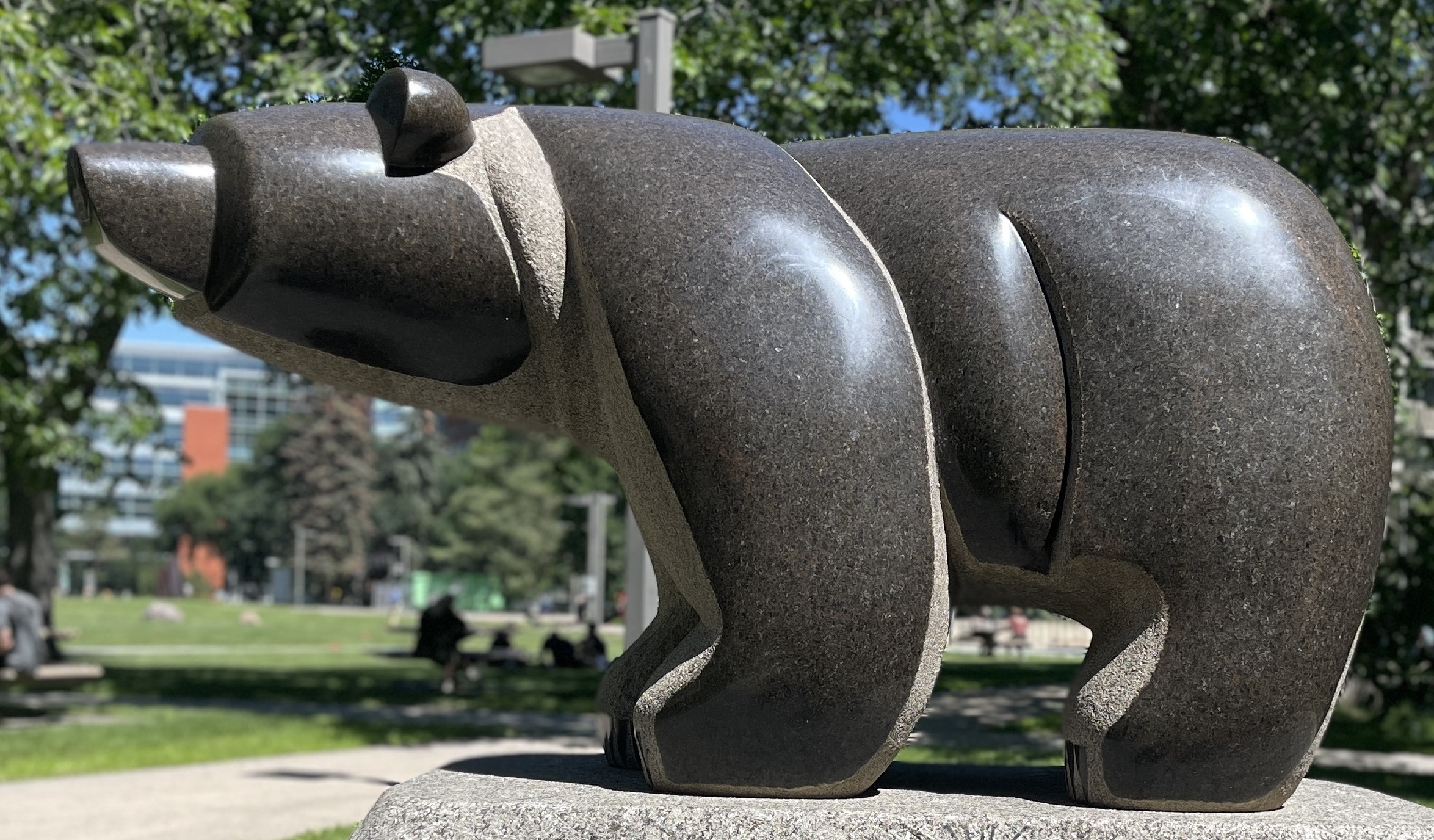
Image Credit: Debbie Feisst & University of Alberta, Spirit Bear granite carving by Stewart Steinhauer.
The COPPUL Indigenous Student Award was created to support aspiring Indigenous librarians and archivists. This post-secondary scholarship is offered in partnership with Indspire, an Indigenous national charity that invests in the education of First Nations, Inuit, and Métis people for the long-term benefit of these individuals, their families, and communities. The award is funded by COPPUL members; Indspire administers the award and provides matching federal funds through Indspire’s Building Brighter Futures program.
Two awards of up to $22,000 each are offered each year. Eligibility is open to Indigenous students from Western Canada enrolled in ALA-accredited master’s programs in Library and Information or Archival Studies (or equivalent) at post-secondary institutions in Canada, or in online programs offered by universities abroad.
The Oskâpêwis Mentorship program also provides an opportunity for Indigenous library, archive, and other information-related employees and students to form a strong mentoring community.
The Oskâpêwis Mentorship program was created to support Indigenous employees and students of libraries, archives, and other information-related fields. While COPPUL is a consortium focused on Western Canadian academic libraries and provides administrative support in this capacity, Oskâpêwis is open to Indigenous people working in all library types (public, academic, school, special) across the nation known as Canada. Students in Library Technician, MLIS, and MAS programs are welcome, as are people at all stages of their career (early, mid, late).
Libraries and educational institutions are inherently colonial institutions, and in Canada there is a history and current practice of assimilation tactics and abuse within these systems which have intergenerational impacts. Oskâpêwis organizers aim to develop a safe space to help resolve these challenges. We recognize the desire of non-Indigenous information students and practitioners to support Indigenous colleagues, patrons, and initiatives. However, Oskâpêwis Mentorship is only open to Indigenous information students and practitioners.
We welcome new members on an ongoing basis. If you are an Indigenous information student or practitioner who would like to join, please contact COPPUL’s Indigenous Knowledges Coordinator at ikcoordinator@coppul.ca.
“Unity” by Jillian Metchooyeah (Dene)
Artist’s Statement:
The circle shape is significant for many Indigenous peoples. It can represent cycles in nature, cycles in life; there are sacred circles, healing circles, talking circles, and more. They can represent interconnectivity with each other, with the self, or with the world. I wanted there to be circle symbolism in the piece and I chose to represent that with a sweetgrass braid. Stronger when braided together, braided sweetgrass represents the strength of community; it also represents healing.
Since libraries and other educational institutions are inherently colonial institutions, I wanted to include a symbolic reference to the Treaty promises, which were made to last as long as “the sun shines, the grass grows, and rivers flow.”
I used a mountain shape to symbolize permanence, because all of us Indigenous people are still here, and here we will remain. Teepees have an importance to many Indigenous groups, and can be a symbol of community. So, I made the mountain in a shape that could also be seen as a teepee.
Fires can be seen as a way to bond together, heal, and are present at ceremonies and events. It could also represent new life. The lines that come off either side of the mountain could be smoke, or could be a river. Either way, smoke or river, it can represent healing.
I tried to incorporate things that represent community, healing, hope, and unity while also including representations of the Treaty promises.
The Indigenous Historical Publications Working Group (IHPW) is responsible for guiding efforts to improve discovery of, access to, and preservation of publications by and about Indigenous communities on whose lands COPPUL members live and work. These publications could include newspapers, newsletters and various forms of grey literature. Its membership includes 6-8 members from full COPPUL member institutions. Please visit the IHPWG page for more information.
Commercially available information resources about Indigenous Peoples in Canada – whether historical or contemporary – have long represented the colonial settler perspective. Content ranging from scholarly monographs and articles, to ethnographic video studies, to primary source archives pertaining to settler-Indigenous relations and interactions – going back to the earliest colonial contact – commonly focuses on Indigenous histories, knowledges, practices and more as subjects to be studied from a western colonial intellectual and academic tradition. The associated research, in turn, has and continues to acknowledge and respect the sovereignty of Indigenous Peoples over their knowledge, practices, and lived experiences.
Many COPPUL libraries’ collections contain content that fits this characterization. As libraries work towards truth-telling and reconciliation, it is imperative that we acknowledge that our collections hold harmful materials, notwithstanding the historical value in making it available for study. It is incumbent upon libraries to work with traditional library vendors to situate information resources in ways that provide truthful context for readers.
When vendors sell historical content to libraries that include settler-colonial representations of history and Indigenous peoples, such as primary source archives, libraries must advocate for the inclusion of Indigenous Elders and Knowledge Keepers in the review of the content and in the preparation of any framing contextual information.
Libraries should actively advocate for a reconsideration and rewriting of descriptive language that reflects the values of earlier eras, (e.g. “pioneers”, “explorers”, “discovery of new lands”, etc.). Terminology should reflect the history of settler-Indigenous relations as we now know it to be, including the reframing of resources already in library collections.
Libraries should advocate for vendor consideration of First Nations Principles of OCAP – “ownership, control, access, and possession…(which) assert that First Nations have control over data collection processes,and that they own and control how this information can be used.” https://fnigc.ca/ocap-training/
Privileging Indigenous Publishers and Distributors
It is incumbent upon libraries to actively seek information sources from Indigenous vendors and creators. We must work towards balance in our collections by adding sources – in all formats – by and for Indigenous authors, researchers, film makers, and other creators.
COPPUL member libraries may work to form their own recommendations for vendors and suppliers. For example Vancouver Island University librarians Jean Blackburn, Dana McFarland and Patricia Geddes have developed “SITUATING REPRESENTATIONS OF INDIGENOUS KNOWLEDGE IN PLACE & CONTEXT: RECOMMENDATIONS FOR VENDORS” (2021).
In the Spring of 2021, COPPUL partnered with Emerald Publishing and the University of Saskatchewan to realize one of COPPUL’s strategies to “explore models for extending licensed material to Indigenous communities”. The pilot project extends free access to the University’s Emerald 120 e-journals package to Indigenous communities in Northern Saskatchewan and Northern Manitoba. This pilot has been extended until the end of December 2024.
The First Voices First project shares relevant information and research content beyond the walls of academia. In doing so, this project helps correct historical wrongs when it comes to research and Indigenous peoples. In the past, Indigenous peoples were overly researched and yet did not have access to the research done about them. Western researchers benefited immensely from this research across their career development.
During the pilot, Emerald will provide author support for Indigenous scholars and community research partners. The long-term goal of this project is to encourage discussion and knowledge development in Indigenous scholarly authorship.
Ongoing evaluation, including usage of the database, during the pilot will determine whether the project will be expanded to include other interested COPPUL institutions and other potential publishers and vendor partnerships. A sustainable business model and framework for access and community engagement to ensure long-term access to Indigenous communities across Western Canada will also be explored.
Since 2017, the COPPUL IKSC has focused on working towards a solution to the now well-known problem of the inappropriate, missing, and inaccurate words used to describe Indigenous peoples, topics, geographies, languages, and timelines. This page outlines some of the key efforts to support conversations leading towards enhanced understanding of the technical problems in tandem with the somewhat better understood word context problems.
2018 – Making Meaning Symposium – at the University of Alberta
Publication from the event: Leonhardt, E. (2018). Impacts and Reflections on the Making Meaning Symposium for Small, Independent Libraries. Evidence Based Library and Information Practice, 13 (4), 7–14. https://doi.org/10.18438/eblip29441
2018 – In Our Own Words: Decolonizing Description in the Library and Archival Community at York University & Toronto Metropolitan University
An Indigenous library employee or student may find themselves in an environment without additional Indigenous colleagues and in need of support and mentorship. Often there is a highly colonial work environment that a new Indigenous library professional will have to deal with and this will create discomfort. As well, Indigenous students in information schools (including library and archival programs) will likely encounter some hegemonic situations due to universities being colonial institutions, as well as the lack of Indigenization within program curricula. The IKSC wishes to facilitate a sense of belonging for Indigenous peoples in information studies and the professions. This is being realized through initiatives such as the Oskâpêwis Mentorship program and a COPPUL scholarship for Indigenous students enrolled in library/archives master’s degree programs.